
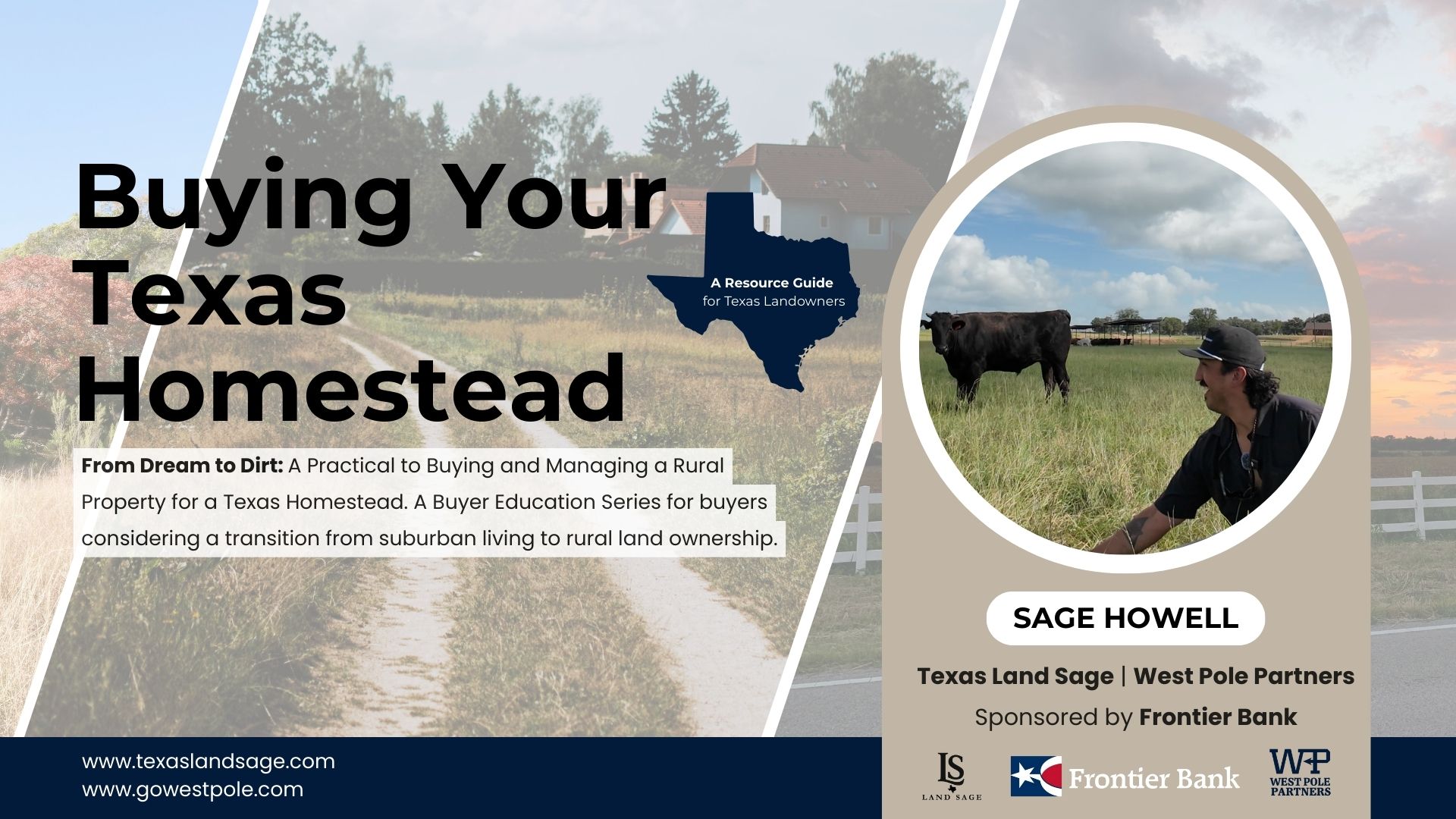
From Dream to Dirt: A Practical to Buying and Managing a Rural Property for a Texas Homestead. A Buyer Education Series for buyers considering a transition from suburban living to rural land ownership. This is a post that covers the Monthly Webinar and in person event in Cedar Park, Texas with Sage Howell at the Texas Land Sage offices.
Buying Your Texas Homestead
Welcome, and thank you for joining us. My name is Sage Howell and I am a Land Specialist with West Pole Partners. I specialize in Commercial, Agricultural, and Rural real estate and love connecting people to the land.
Today’s session is called Buying Your Texas Homestead, From Dream to Dirt: A practical guide to buying and managing a rural property for a Texas Homestead. This webinar is designed for buyers who are considering a move away from suburban living and want to understand what it really takes to buy and use rural land correctly and the things to watch out for when looking for rural land.
We’ll cover what modern homesteading looks like today, what kind of land actually works, common mistakes buyers make, and how financing rural property differs from a standard home purchase. This session is educational and practical, and by the end, you should have a much clearer framework for deciding whether land ownership is the right next step for you.
Basic Step-by-Step Buying Land for a Homestead
1. Know Your Vision – Purpose drives property choice – WHY & WHERE?
2. Evaluate the Land – Soil, water, access, zoning, ecology – WHAT?
3. Understand the Legal & Financial Landscape – Title, mineral rights, easements, financing options.
4. Inspect Infrastructure – Utilities, septic, roads, fences.
5. Close & Steward – Buying process + long-term management.
Homestead = Your vision. Could be anything from small gardens to livestock or off-grid living. I envision it as a place to expand my community while producing food with my time.
Raw land requires evaluating zoning, water access, soil quality, utilities, and potential restrictions. Utilizing
Purpose: Give you a step-by-step plan so your land purchase is informed and secure.
Why Texans Are Leaving the Suburbs
Across Central Texas, we are seeing a consistent trend. Buyers are leaving traditional subdivisions and looking for space, flexibility, and long-term control over their lifestyle.
Many are reacting to increased density, stricter HOA rules, rising property taxes, and a general feeling that suburban life offers fewer options than it once did. Others are thinking more proactively about food security, long-term land value, and how they want to live ten or twenty years from now.
The important thing to understand is that this shift does not require moving out of Texas or going fully off-grid. For many buyers, it simply means changing how and where they live.
What is Modern Homesteading
When people hear the word ‘homesteading,’ they often picture pioneer life or extreme off-grid living. That is not what modern homesteading means for most Texans today.
Modern homesteading is about intentional land use. It’s about producing some of your own food, reducing dependency where it makes sense, and using land efficiently over time.
Most modern homesteads are not large ranches. They are often one to ten acres, located within reasonable distance of towns, schools, and services. Homesteading today is flexible, incremental, and designed to fit real-world schedules and budgets.
Who Are Today’s Homesteaders
There is no single profile for a modern Texas homesteader. We work with families leaving subdivisions, couples who work remotely, professionals planning ahead for long-term lifestyle changes, and retirees who want land without the burden of a large house.
What these buyers have in common is not age or income—it’s mindset. They want independence, flexibility, and options. They are not necessarily trying to do everything themselves, but they want the ability to do more if they choose.
What Does A Homestead Look Like
A modern homestead is built over time.
A homestead today isn’t about going off-grid or doing everything yourself. It’s about intentional land use—owning a few to a few dozen acres that support how you want to live. That might mean space for a garden and animals, reliable water, light infrastructure, and the freedom to build without over-restriction. A modern homestead balances self-sufficiency with practicality: close enough to town for work and community, far enough out to steward land, raise food, and build something lasting.
Define Your Homestead Goals
The first step in your homesteading journey is defining your goals. Think about what you want to grow, which animals you want to raise, and how you want to live.
Do you want to be fully off-grid or have access to utilities?
Your land’s location and climate are also critical. Texas has diverse climates—East Texas has forests and rainfall, Central Texas Hill Country has rocky soils and rolling hills, West Texas is dry and arid. Each affects what’s possible for homesteading.
Searching and Evaluating Texas Land
Finding the right property takes research and boots-on-the-ground inspections. Work with an agent specializing in Texas rural land or explore online platforms. Always visit the property multiple times—different seasons reveal challenges like flooding, drainage, or access roads.
Evaluate key features: soil quality, water sources, and any existing infrastructure. Soil testing ensures you can grow what you want. Reliable water could come from wells, springs, or municipal supply. Existing roads, fences, and barns save time and money.
Soil testing: Test pH, fertility, and composition.
Water: Check well depths, water rights, or spring reliability.
Topography: Hills, drainage, and erosion risk.
Due Diligence
Due diligence is where many buyers avoid trouble. First, conduct a title search to ensure the seller owns the land and there are no liens. A professional land survey confirms boundaries and easements. Check zoning, HOA rules, and any covenants that might restrict your activities. Environmental assessments are also important, especially if you plan livestock, crops, or building structures.
Title search ensures ownership is clear.
Survey confirms acreage and boundaries.
Check zoning: agricultural vs. residential vs. commercial.
Environmental assessment: Floodplains, protected species, soil contamination.
Making an Offer, Negotiate, Closing
When you’ve done your homework, it’s time to make an offer. Use your due diligence findings to negotiate a fair price. Include contingencies—like inspection or financing clauses—so you can walk away if problems arise. If the seller offers financing, you can negotiate interest rates, down payment, and payment schedule to make it work for both sides.
Offer based on land condition, improvements, and market comps.
Contingencies protect your investment.
Why Work With Sage Howell
Buying rural land is fundamentally different from buying a home in a subdivision. Access, water, easements, restrictions, and land usability matter far more than cosmetic features.
A land-focused realtor helps buyers evaluate whether a property actually supports their intended use—now and in the future. Mistakes in land purchases are often permanent and expensive.
Good representation is not about finding land. It’s about avoiding the wrong land.
Budget and Financing Options
Next, we need to talk budget. Beyond the land cost, you need to account for property taxes, closing costs, and development expenses like water wells, fencing, or electricity.
Financing raw Texas land is different from buying a house. You might explore USDA farm loans for eligible farmers, Farm Credit institutions, raw land loans, or owner financing.
Typical raw land loans require 20–30% down payment, higher interest.
USDA Farm Loans can help small farmers and homesteaders.
Owner financing can be a flexible option if the seller is motivated.
Land that already has improvements—like a well, septic system, or road—may qualify for better financing terms.
Buy Rural Land with Texas Land Sage
If you are considering a move from the suburbs to rural land, the next step is education and planning.
Work with a land-focused brokerage. Finance through a lender that understands rural property. And take the time to buy land that truly supports your goals.
Thank you for joining us. If you would like help evaluating land or understanding rural financing options, we invite you to reach out and continue the conversation.
If you liked this webinar please look at our other resources located in the Texas Land Sage – Knowledge Center
If you would like to sign up for our next in person Coffee & Community Event in Cedar Park, Texas please RSVP using this EventBrite Link
Coffee & Community – Buying Your Texas Homestead

"The earth is the Lord's and the fullness thereof, the world and those who dwell therein." Psalm 24:1 (ESV)
Brokerage KW Austin Southwest 1801 S Mopac Expy. #100, Austin, TX 78746
Leader & Team Sonny Allen – West Pole Partners
TX License: 830034 Sage Howell
Contact Us
- sage@gowestpole.com
- 817-408-8585
- Texas Land Sage - 13402 Anderson Mill Road Cedar Park Texas 78613