
Understanding the 1031 Exchange for Texas Landowners
A 1031 Exchange is one of the most powerful tax-deferral tools available to serious landowners. When structured correctly, it allows you to sell investment or business-use real estate and reinvest the proceeds into another qualifying property—without immediately paying capital gains tax.
For Texas ranchers, ag operators, and land investors, this strategy is often the difference between downsizing wealth and compounding it.
What Is a 1031 Exchange?
A 1031 Exchange refers to Section 1031 of the Internal Revenue Code. In simple terms:
“Whenever you sell business or investment property and you have a gain, you
generally have to pay tax on the gain at the time of sale. IRC Section 1031 provides an exception and allows you to postpone paying tax on the gain if you reinvest the proceeds in similar property as part of a qualifying like-kind exchange. Gain deferred in a like-kind exchange under IRC Section 1031 is tax-deferred, but it is not tax-free. The exchange can include like-kind property exclusively or it can include like-kind property along with cash, liabilities and property that are not like-kind. If you receive cash, relief from debt, or property that is not like-kind, however, you may trigger some taxable gain in the year of the exchange. There can be both deferred and recognized gain in the same transaction when a taxpayer exchanges for like-kind property of lesser value.”
IRS Like-Kind Exchanges Under IRC Section 1031
You can defer capital gains taxes when you sell investment real estate, as long as you reinvest in another “like-kind” investment property.
“Like-kind” in real estate is broad. It does not mean identical property types. You can exchange:
- Ranch → Hunting property
- Farmland → Commercial tract
- Recreational land → Income-producing rental
- Large acreage → Multiple smaller tracts
The key requirement: Both the relinquished property and replacement property must be held for investment or business purposes.
Primary residences do not qualify, but you already knew that right? 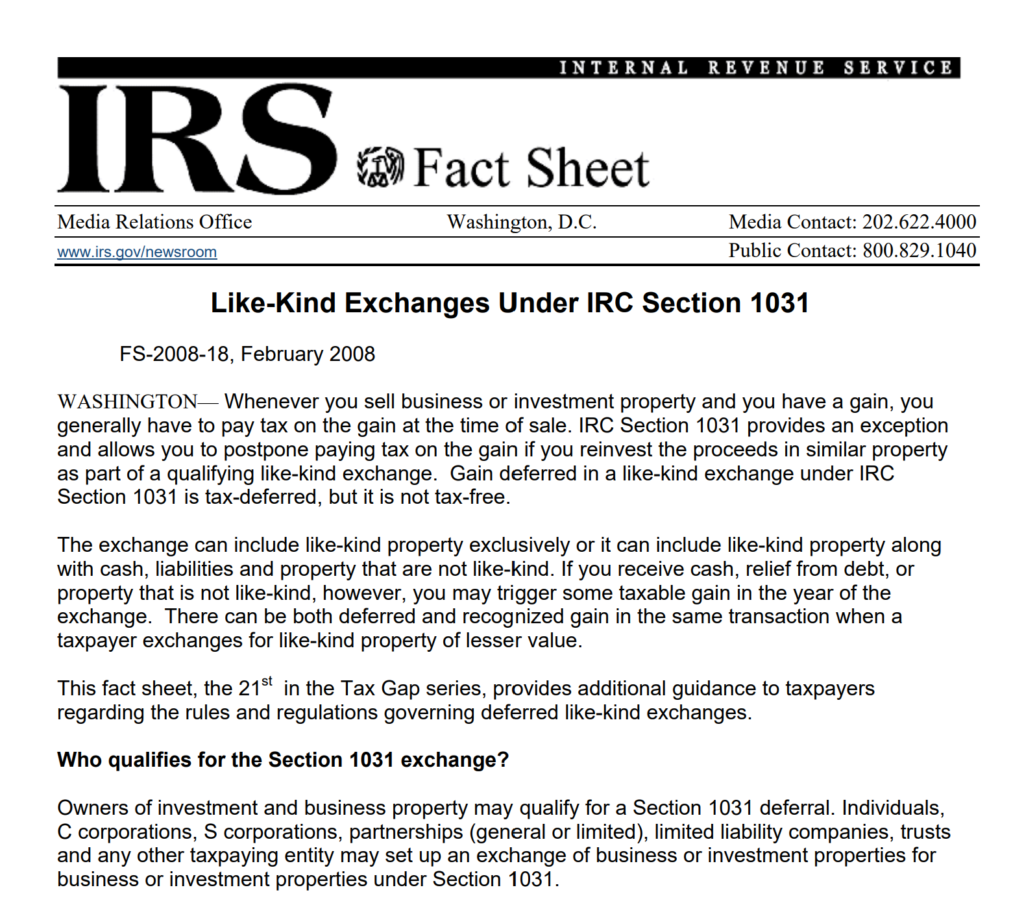
Why It Matters for Texas Landowners
In Texas, land appreciation over the last decade has been substantial—especially in counties like Williamson, Lee, Bastrop, Burnet, Llano, and Gillespie. For owners who purchased acreage years ago at lower price-per-acre levels, a sale today could trigger significant:
Federal capital gains tax
Depreciation recapture (if applicable)
Potential state-level considerations elsewhere
A 1031 Exchange defers those taxes, keeping that capital invested instead of sent to the IRS.
For example:
If a ranch sale produces $1,000,000 in gain, the tax liability could easily approach $200,000–$300,000 depending on structure. A 1031 allows that entire equity position to roll into the next property.
That difference compounds.
How the Process Works
The structure must be precise. A typical 1031 Exchange includes:
- Sale of the Original Property – You sell your investment ranch or land tract. The proceeds do not go directly to you. Instead, they are held by a Qualified Intermediary (QI – Allied resource that is trusted and vetted to hold the funds).
- 45-Day Identification Period -From the day of closing, you have 45 days to identify replacement properties in writing.
- You can identify: Up to 3 properties of any value, or More properties under specific valuation rules
- 180-Day Closing Window – You must close on one (or more) of the identified properties within 180 days of the original sale. Miss these deadlines and the exchange fails.
When a 1031 Exchange Makes Strategic Sense
A 1031 is not automatic. It works best in scenarios such as:
- Trading Up – You sell 200 acres and consolidate into a higher-quality 150-acre ranch with better water, access, and wildlife.
- Diversification – You exchange one large tract into:
- A hunting property
- A small commercial development tract
- An income-producing rental asset
- Geographic Repositioning – Moving from one region of Texas into a stronger appreciation corridor.
- Transitioning Asset Type – Moving from raw land into cash-flow-producing property without losing equity to taxes.
When It May Not Make Sense
This strategy is not for everyone. There is a timeline and lots of positioning prior to execution.
A 1031 may not be appropriate if:
- You need liquidity for personal use.
- You’re exiting real estate entirely.
- The replacement property options are limited or overpriced.
- Estate planning strategies (like step-up in basis at death) are more advantageous.
This is where coordinated planning with a CPA and intermediary becomes critical.
Advanced Considerations for Ranch & Agricultural Owners
Ag Exemptions
An exchange does not automatically eliminate agricultural valuation. However, if the new property changes use, that could impact appraisal district treatment.
Improvements During Exchange
You can structure a “build-to-suit” or improvement exchange, but this requires more complex planning.
Partial Exchanges
If you pull some cash out (“boot”), that portion becomes taxable.
Successive Exchanges
Some investors use multiple exchanges over decades, continuously compounding equity and deferring gains.
In Texas land brokerage, this is often how families scale from mid-size holdings into legacy ranch portfolios.
Common Misconceptions of a 1031
“It’s only for commercial buildings.”
False. Raw land qualifies.
“You have to buy the exact same type of property.”
False. “Like-kind” is broad within real estate.
“It eliminates taxes.”
Not exactly. It defers them. However, if held until death, heirs may receive a stepped-up basis under current tax law.
Real-World Texas Examples
An owner in Central Texas sells a 224-acre tract near growth corridors outside Austin in Lee county Texas. Appreciation has gone up 46% in 2 years. This is an aggressive valuation movement.
Let’s walk through the mechanics of this repositioning strategy in practical terms. 
We have the known:
- 224 acres in Lee County
- 2023 taxable value: $1,087,860
- 2025 taxable value: $1,592,460
- ~46% appraisal increase in two years (good grief that is a growth corridor signal if I have ever seen one).
Instead of selling and paying capital gains on the appreciation, the owner executes a 1031 Exchange.
Step 1: Sale of the Lee County Ranch (Identified as an Investment Property)
Assume sale price aligns near $1,600,000.
Capital gain (simplified) ≈ $350,000–$400,000 depending on basis.
If sold outright:
- 20% federal capital gains
- 3.8% NIIT
- Possible depreciation recapture
- Estimated immediate tax exposure: ~$80,000–$120,000+
- That capital leaves the portfolio.
Step 2: Don’t Realize Those Gains – Execute 1031 Exchange
Instead of taking proceeds:
- Funds go to Qualified Intermediary
- 45 days to identify replacement property
- 180 days to close
- They identify a 300-acre East Texas hunting property priced at $1,600,000.
What That Means Structurally
Before
- 224 acres
- Higher per-acre valuation corridor (as indicated by the appreciation of the land value)
- Increasing tax pressure
After
- 300 acres
- Lower per-acre cost basis
- Strong timber + wildlife upside
- Reduced urban pressure exposure
They preserved:
- Full $1.6M equity
- No immediate tax payment
- Larger acreage footprint
- Acreage Math
Lee County implied 2025 taxable value (without AG use taken into consideration):
≈ $7,111 per acre
East Texas 300-acre tract at $1.6M (without AG use taken into consideration):
≈ $5,333 per acre
They effectively:
- Increased acreage by 76 acres
- Lowered per-acre capital concentration
- Improved hunting/recreational scale
Strategic Outcome
More acreage.
Full equity preserved.
Deferred capital gains.
New upside profile.
The key is that no tax event was triggered today.
The owner converted appreciation into scale.
The Strategic Mindset
A 1031 Exchange is not simply a tax tactic. It is a capital allocation decision.
It asks:
- Is this property still the highest and best use of my equity?
- Can I reposition into stronger water, better access, improved wildlife habitat, or commercial upside?
- Am I compounding capital—or crystallizing taxes?
- For serious landowners building generational wealth, these questions matter.
A properly executed 1031 Exchange can:
- Preserve capital
- Increase purchasing power
- Enhance portfolio quality
- Strengthen long-term land strategy
It requires coordination between your broker, CPA, attorney, and a qualified intermediary. The timelines are rigid, and errors are costly.
But when done correctly, it keeps your money in land—working for you.
If you are considering selling a ranch, hunting property, or investment tract in Texas and want to evaluate whether a 1031 strategy fits your situation, begin planning before you list. Timing and structure determine success.
Capital preserved is capital compounded.
Why Education Matters
Our mission at Texas Land Sage is to help buyers cut through noise, understand land realities, and make decisions rooted in clarity—not pressure.
If you’re considering buying Texas land this year, the opportunity is real—but so is the responsibility to get it

"The earth is the Lord's and the fullness thereof, the world and those who dwell therein." Psalm 24:1 (ESV)